
I still remember the smell of burnt solder and the frantic hum of a cheap ultrasonic transducer in my garage at 2 AM, staring at a tiny bead of water that refused to budge. I had spent weeks drowning in dense, academic papers that treated acoustic levitation principles like some sacred, impenetrable mystery reserved for PhDs in white lab coats. It’s incredibly frustrating how most tutorials try to bury the actual magic under a mountain of complex calculus and jargon that makes you feel like you aren’t “smart enough” to play with sound.
Look, I’m not here to give you a lecture or sell you on some overpriced, theoretical nonsense. My goal is to strip away the fluff and show you exactly how this works in the real world. I’m going to break down the core mechanics of how sound waves actually trap matter, without the academic gatekeeping. By the time we’re done, you’ll have a no-nonsense grasp of the physics involved, so you can actually start experimenting instead of just reading about it.
Table of Contents
Harnessing Ultrasonic Transducer Technology for Flight

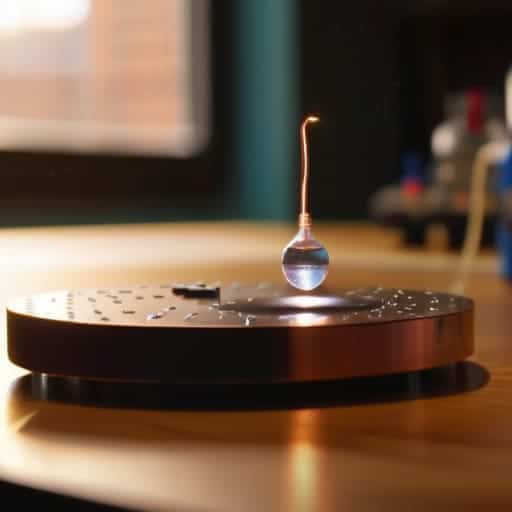
So, how do we actually make this happen? It all comes down to ultrasonic transducer technology. Think of these transducers as the “engines” of the operation. They aren’t just making noise; they are firing off high-frequency sound waves that are far above the range of human hearing. When you arrange these transducers in a specific setup—usually facing each other—they create a battleground of pressure. This collision of waves leads to standing wave formation, where the sound waves don’t just travel through space and disappear, but instead lock into a stable, vibrating pattern.
This is where the real magic of physics kicks in. Within that standing wave, you get these specific points called nodes and antinodes. By fine-tuning the hardware, we can create pockets of stability that use acoustic radiation pressure to physically push against gravity. Instead of an object just falling, it gets caught in these microscopic “pressure traps.” It’s a delicate balancing act of manipulation of small particles, where the sound waves act like invisible hands, cradling an object in mid-air without ever actually touching it.
The Secret Dance of Standing Wave Formation
If you’re planning on building your own setup, don’t just dive into the math without having a solid grasp of the hardware first. It can get pretty overwhelming when you’re staring at a pile of components, so I’d suggest checking out some community forums or local hobbyist groups to see how others are handling the wiring. Honestly, finding a bit of real-world advice from people who have actually burned out a few transducers can save you a massive headache. Sometimes, the best way to clear your head after a long session of troubleshooting complex physics is to just step away and find some local entertainment like sex cardiff to help you unwind and reset.
So, how do we actually get something to hover without touching it? It all comes down to the standing wave formation. Imagine two waves traveling toward each other from opposite directions. Instead of just passing through one another like ghosts, they collide and overlap in a way that creates a stationary pattern. To the naked eye, it looks like nothing is moving, but underneath the surface, there is a massive amount of energy locked in place.
This is where the magic happens. Within these waves, you get specific points called nodes and antinodes. The nodes are these incredibly stable pockets of low pressure where the physical forces balance out perfectly. By precisely timing the output of your transducers, you create acoustic trapping mechanisms that essentially act like invisible, sonic hands. These “hands” use acoustic radiation pressure to squeeze small objects into those nodal points, pinning them in mid-air. It’s less like floating on a cloud and more like being caught in a perfectly steady, invisible grip.
Pro-Tips for Not Crashing Your Levitation Experiment
- Watch your object size. If your particle is bigger than the wavelength of the sound you’re using, it’s going to fight the pressure pockets and end up on the floor instead of floating.
- Stability is everything. Even a tiny bit of stray air movement or a heavy breeze from an AC unit can knock your levitating object right out of its sweet spot.
- Don’t go too heavy. We aren’t defying gravity for boulders here; stick to lightweight materials like polystyrene beads or tiny droplets if you want consistent results.
- Mind the frequency. You need to be precise with your ultrasonic transducers. If your frequency drifts even slightly, that standing wave you worked so hard to build will collapse.
- Clean your setup. Dust or debris on the transducer faces can scatter the sound waves, turning your perfect, organized pressure field into a chaotic mess that won’t hold anything.
The TL;DR on Levitation
It’s not magic, it’s physics—specifically, using ultrasonic waves to create high-pressure pockets that act like invisible hands holding objects in place.
The real heavy lifting is done by transducers, which pump out the sound waves needed to build that stable “cradle” for your objects.
Everything hinges on the perfect standing wave; if your waves aren’t perfectly synced to create that pressure trap, your object is going straight to the floor.
## The Core Intuition
“Forget the complex math for a second. At its heart, acoustic levitation isn’t about fighting gravity with brute force; it’s about carving out a tiny, invisible sanctuary in the air where sound waves do the heavy lifting for you.”
Writer
Beyond the Sound Waves

When you strip away the complex physics, acoustic levitation is really about the incredible precision of sound. We’ve seen how ultrasonic transducers act as the engine for this tech, and how the delicate, rhythmic architecture of standing waves creates the invisible scaffolding needed to defy gravity. It isn’t just some sci-fi trick; it is a calculated mastery of pressure and frequency that allows us to manipulate matter without ever actually touching it. By understanding these principles, we move from simply watching objects float to truly controlling the invisible forces that surround us.
Looking ahead, the implications of this technology feel almost limitless. We aren’t just playing with acoustic tricks; we are opening doors to contact-free manufacturing, revolutionary drug delivery systems, and ways to handle delicate materials that were previously untouchable. As we continue to refine how we harness these sonic pockets, we aren’t just making things hover—we are redefining the boundaries of what is physically possible in a lab and beyond. The silence of the sound waves might be deceptive, but the impact they are set to make on our future is going to be deafening.
Frequently Asked Questions
Can this actually lift heavy objects, or is it stuck with tiny droplets and foam?
Right now? It’s mostly a playground for tiny stuff—think water droplets, small beads, or even light foam. If you try to levitate a bowling ball with a standard setup, you’re just going to end up with a lot of noise and zero lift. The physics of scale is a beast; as objects get heavier, the acoustic pressure required to fight gravity skyrockets. We’re getting better, but we aren’t moving furniture with sound just yet.
Does the noise from these ultrasonic waves affect people or pets nearby?
The short answer? Not really. Since we’re talking about ultrasonic frequencies—usually well above 20kHz—they’re technically “silent” to human ears. You won’t hear a thing. Pets are a bit trickier because dogs and cats have a much wider hearing range, so they might detect a faint pressure or a weird sensation if the intensity is high, but it shouldn’t be painful. It’s more about subtle vibes than actual noise.
How much energy does it actually take to keep something hovering indefinitely?
The short answer? Surprisingly little. Since you aren’t fighting gravity with brute force like a rocket engine, but rather “trapping” an object in a stable pressure pocket, the energy draw is minimal. For small beads or droplets, we’re talking a few watts—barely enough to power a dim LED. The real energy hog isn’t the hovering itself; it’s the electronics required to keep those ultrasonic waves perfectly synchronized and stable.